Showing posts with label Trimming. Show all posts

Friday, January 13, 2012

Hair Myth: Trimming makes your hair grow faster!

MYTH: The more you trim your hair the faster it'll grow!
FACT: I've heard this said many times and many ways, but it simply isn't true.

~~~~~~~~~~~~~~~~~~~~

Your hair technically isn't alive, so it doesn't know its being cut. If it were alive then you'd feel the pain from the cut.The only "live" part of your hair is the follicle, which is in your scalp. Trimming split ends off when necessary will make your hair appear to be longer by making it look more uniform and healthy.

~~~~~~~~~~~~~~~~~~~~

Fast Facts:
  • Hair grows about 1/4 to 1/2 an inch per month no matter how much you cut
  • Ridding your hair of damaged ends will reduce breakage and help retain length
  • Overall health, genetics, and hormones determine hair growth
  • Hair that's cut short only appears to be thicker, because the width of hair closer to the scalp is thicker than hair farther away
~~~~~~~~~~~~~~~~~~~~

Like my Facebook Fan Page to get other useful hair facts, and info!!

Thursday, January 5, 2012

Transitioning Tips: Breakage

I think one of the top issues I had while transitioning from relaxed hair to natural hair was preventing breakage. Breakage is the result of your hair not being strong enough, or able to withstand being manipulated. Even healthy hair can break if the force is great enough and limits are exceeded. Breakage was also a motivator for me to be chemical free. There are a number of ways to stop, and prevent breakage from happening. Here are five tips that I find useful and would suggest to others.

Trim your ends!
I know it can be hard to let go of your hair, but if you neglect to trim your ends when necessary you'll end up losing a lot more in the long run. Some sources suggest trimming every couple of months. I suggest trimming when necessary, because you may not have split ends or damage after 6 months. BUT if you ignore damaged ends they'll literally fray, and split up the hair shaft like a loose rope unraveling. The only way to correct this is to cut it off. There are products and methods you can use to temporarily solve this, but extreme split ends are definitely preventable. Neglect in this way can go from needing a minor trim to needing a major cut! Split or damaged ends can become dehydrated quickly, which leads to brittleness. This brittleness is what makes your hair snap off at its weakest point.

Be mindful when using heat!
Over use of heating tools, and lack of heat protector can lead to damaged hair strands, follicles and/or scalp. All of these need to be healthy to maintain health hair, length, and to prevent breakage. Over time heat will lead to damage if used in excess. Heat damage can come from curling irons, flat irons, hair driers, hot rollers, and even the sun! Constantly applying heating tools to your hair weakens it. You can cause permanent damage the first time you apply a heating tool to your hair by incorrect use!

Maintain a healthy diet!
I don't mean start a crash diet, swear off meat, and sign up for a marathon. You should however be conscious of how healthy, and what you eat. Good nutrition and healthy hair do correlate to each other. An imbalanced diet consisting of too many sugars and fats (for example) can be a cause of dry, brittle hair. Both of these lead to breakage. Eating a well balanced diet will allow your scalp and hair to be at its healthiest condition. If certain vitamins/nutrients are missing then you're depriving your scalp and hair of what it needs to stay strong and to combat breakage.

Moisturize & condition!
Keeping your hair sufficiently conditioned and moisturized will help it maintain its flexibility and elasticity. The more flexible and elastic the strands are the less likely they are to break from tension, stretching, and general manipulation. Water is a great moisturizer, and conditioning your hair while it's wet is one of the best times! Hair absorbs conditioner the best when it's clean, and rid of buildup. I'd suggest washing at least once a week. If your hair is dry, from lack of moisture, then waiting longer to wash it is doing more harm than good. Moisturizers will penetrate the hair and conditioners will help smooth and seal it in. If your hair is breaking very easily, lack of moisture is most likely the culprit.

Beware of tension!
Constant tension on any part of your hair will eventually lead to breakage, thinning, or even permanent hair loss. Tension can come from headbands, elastics, rubber bands, hair ribbons, braids, ponytails, etc. Frequent rubbing (friction) from elastics, for example, can weaken the hair at that section. Over time this part of the hair can break off. Pony tails that are too tight can also cause excessive tension at the hair line. Continually doing this can damage the individual hair follicles permanently, leading to traction alopecia. If you're getting headaches, a sore scalp, or tender head from a style/tool, then it is too restricting!

While transitioning it's very important that you stay aware of your hairs condition and state. Preventing breakage will ease the process, and help you maintain length!


The part of your hair where your natural hair meets the relaxed hair (above in pink) is the weakest of the strand!! It's extremely important to take care while styling, washing, etc. Staying on top of conditioning can help protect this area and minimize breakage.

It can be challenging to blend the two textures of hair while transitioning. Don't let this discourage you!

Style Ideas:

Do you have any styles that you'd suggest to someone who's transitioning? Any tips?? Follow me on http://www.twitter.com/mzdezy and share!!


Thursday, November 17, 2011

Makeup of Hair

Your hair is made up of a few parts, and is a little complex. Understanding these parts, and their individual functions can be beneficial when it comes to achieving healthy hair, and scalp. It's also very important in growing long, healthy hair, and maintaining the hair you have currently.


The main parts of your head of hair involve your scalp, hair, hair follicle, sebum, and the sebaceous gland.
What exactly are these?

~~~~~~~~~~

Hair: Keratin that's composed of two parts; the shaft (the visible part above the scalp) and the follicle (which can't be seen and is below the surface of the skin).

Keratin: Protein that gives hair its strength. It makes up your hair, nails, and top layer of skin.

Follicle: Is the living part of the hair containing blood capillaries. The follicles shape influences the shape of the cortex, which in turn determines what the hair type will be. Ex. curly, straight, wavy

Shaft: Is made of three layered keratin layers. Ex. cuticle, cortex, medulla

Sebum: A natural oil that's produced by the sebaceous glands. It helps protect the skin and hair from drying out. It's usually odorless unless there's bacteria present.

Sebaceous Gland: Responsible for producing oil that protects the hair and skin.

~~~~~~~~~~


To maintain healthy hair it's very important to protect and nourish all parts of your hair.

Cuticle in Detail
  • The outer most layer of hair
  • Gives hair its sheen
  • Made of tight scaled keratin layers- think roof shingles
  • It's transparent
  • Functions as a protective layer to the hair
  • Part that absorbs conditioners
  • Causes tangles and snags if the layers are lifted or damaged
  • Can't repair itself once damaged


Cortex in Detail
  • The second layer of the hair shaft
  • Makes up the majority of the mass
  • Contains pigmented cells that gives hair its color
  • Helps determine the elasticity of hair
  • Area of the hair that experiences damage from heat and chemicals
  • Holds moisture
Medulla in Detail
  • Center of the hair shaft
  • Isn't continuous throughout the length of hair
  • Thick or coarse hair has a medulla
  • Thin hair usually lacks it
  • Blonde hair doesn't have one
  • It's purpose is unknown
~~~~~~~~~~

The shape of your hair follicle determines whether your hair will be straight, wavy, or curly. You can have more than one type of hair, or even curl pattern on your head.


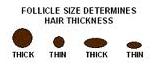
The size of your hair follicle determines the thickness.


~~~~~~~~~~

Hair Facts:
  • There's over 100,000 hair follicles on your head
  • Thick curly hair tend to be short, because sebum can't reach the length of the hair shaft causing the hair to be dry and brittle
  • Hair uses the same cells that are responsible for bone growth
  • There's a muscle fiber connected to the sebaceous gland that controls goosebumps and your hair standing up on end.
  • An unbalanced diet can cause brittle and dry hair
  • Hair gets it shine from sebum the scalp produces
  • Made of about 10% water
  • Animal hooves, claws, and feathers are made of the same thing as your hair - keratin
  • Sebaceous glands are found everywhere except on the soles of your feet and the palms of your hands
~~~~~~~~~~

If growth and retention are important to you when it comes to hair you should keep all of this in mind. Once your hair is damaged (sun, heat, chemical, etc) it can't be undone. To correct badly damaged hair your only option is to cut it. You can temporarily repair hair with smoothers, conditioners, sealants, silicones, etc, but they're not permanent solutions. Making sure you care for your hair properly can help prevent unwanted chops.


All Rights Reserved
If you copy this picture please link back to this site and give me credit ^_^" Thanks!

(Above) Blue: Cut mark   Red: conditioners
1. A healthy hair can experience slight damage from normal wear of a day. Chlorine, dyes, heated tools, winter hats, brushing, and hair accessories can all wear on your hair over time. The key is protecting your hair and being aware of its state. If you keep up with necessary trims there will be minimal hair removed.

2. After a while your hair can become frayed, experience heat damage, or break off from over processing. You may notice uneven pieces of hair, fly aways, or split ends. This is when you want to start taking action before it spreads. Unattended split ends can travel up the length of the hair causing more damage. These splits get caught on each other, and this causes tangles which can cause further damage.

3. Conditioners, silicones, and oil treatments, for example, can help temporarily seal split hairs, but it's not permanent. After washing those seals are removed and need replaced. This is why conditioning is important. Once the cuticle of your hair is damaged it can't repair itself. It's up to you to maintain and protect the hair.

4. If your hair is continually neglected, or trims aren't being done as necessary you may end up having to cut more than anticipated in order to correct the damage.

5. You can see the difference between trims. If you address it early you'll retain more length than if you put it off. Hair grows at about 1/4 inch a month so in order to retain some length you don't want to cut more than that. Example: Roughly 1.5 inches can be grown in about 6 months time. If you trim more than that it's like knocking your hair length back 6 months. So your hair may healthier if it was damaged, but you won't see the growth. That's why it's important to stay on top of it!


How often do you trim your hair? What do you do to make sure your hair is healthy?

Follow me on Twitter @MzDezy or like my Facebook Fan Page and let me know!!