Showing posts with label Transitioning. Show all posts

Friday, April 20, 2012

Step by Step: Hawk Variation

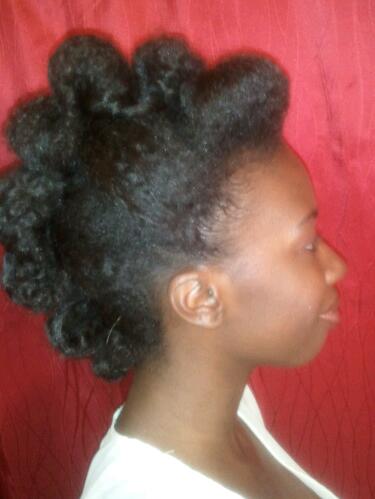
After wearing my hair in a twist out for a while I needed to wash and style it for Easter, but was short on time. Instead I thought of an easy style to get me through the day until I could wash my hair that night. The end result of this style looks like a mohawk made of puffs.

Tools I used: Shea butter mixture, 3 rubber bands, 7 standard sized protected bobby pins, 1 large protected bobby pin, and hair pins (number may vary)


I didn't want to manipulate my hair too much so I didn't use a comb. To begin I smoothed on my shea butter mixture to moisturize my hair and to give it a shine. Next I sectioned my hair into 4 sections making the biggest in the front of my head.


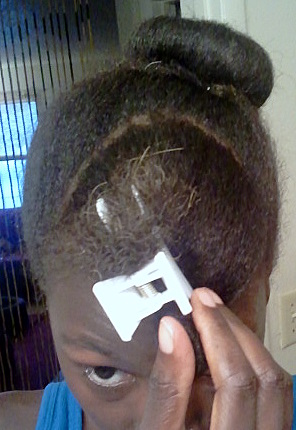
(Right) The red shows where a rubber band is used. The brown shows where rough parts were made.

Tip: If you part your hair using a comb you'll be able to see the parts easier in the finished product. If you use your hands/fingers to section your hair there won't be parts showing in the finished style.

 ~~~~~~~~~~

The very first hump in a basic pompadour secured with one large bobby pin. Once that's completed I moved on to the next pony tail in line. The hair is roughly divided into two parts, rolled, and then secured with a standard bobby pin.

 (Right) The red shows how the pony tail is roughly divided into two parts. The brown shows where the rubber band is securing the ponytail.

Tip: The rubber bands don't have to be very tight, or to pull your hair uncomfortably in any way. The sections that are pinned don't have to be exactly the same size either.

~~~~~~~~~~

After your first section is finished it should look similar to this:

 (Right) The brown shows the direction the hair was rolled. Yellow shows where a bobby pin was placed and red shows the rubber band that was used.

Tip: You can see that the pompadour was bobby pinned in two places since the section was so large. I made the next section's rolls large enough to touch and blend with the roll next to it. You won't notice the rubber bands once the rolls are done.

~~~~~~~~~~

Continue to roll and pin for the remaining pony tails.


Tip: When you section your hair, if you make the sections smaller as you go towards the back of your head the puffs will appear to cascade down your head ^_~" Also, when securing with the standard bobby pins, place one pin on each side of the roll. This will help minimize the amount of bobby pins needed.

~~~~~~~~~~

The last step when all of the rolls are pinned is to just clean up any stray hairs, curls, or make the puffs tighter with the hair pins. Since I started this with hair that had been previously twisted I had random strays all over the place.

After pinning everything how I liked here is the result:


Follow & Tweet me @MzDezy

 ~~~~~~~~~~

Night Care: Since this style is so simple to do I take it down completely and cover with a satin bonnet before bed. In the morning I sprits with my EO water mixture, smooth and restyle.


This hawk variation, puff hawk --- what would you call it?? --- has many pros:
  • Can be worn by people with different hair lengths
  • The number of puffs can be changed very easily to switch up the style
  • People who are transitioning can wear this style
  • Doesn't take a lot of time to style
  • Easy style for people of all skill levels to achieve
  • Can serve as a protective style since the ends of your hair are covered
~~~~~~~~~~

I encourage you to try this style!! If you do make sure you post it on the Facebook Fan Page, so that it may be added to the "Hair I Did" album for others to see! You're welcome to post any and all natural hair pictures of styles you've created or styles that inspire you in some way!

Thursday, March 22, 2012

Hit a Roadblock? Remember: Why you decided to go natural!

I feel like this topic is long over due for me to write about. I know I've been away for a while, but there's a LOT of things going on right now. My laptop is down for the moment, I've been redesigning the blog, I had a mental block, and life has just been happening. This specific topic has been on my mind for sometime now, but I didn't know how to get it out. Deciding to stop chemically processing your hair is a simple decision for some, and a huge step for others. There will be countless obstacles that will arise, especially in the "honeymoon phase" of your newly natural hair. In my next few posts, I'm planning to touch on a few different things that I feel are important to remember, not only in the beginning, but throughout the years you're chemical free.

 ~~~~~~~~~~
When I decided to stop chemically straightening my hair it felt like it was a bigger deal for other people, than it was for me. Some loved it, some were interested, some were indifferent, some had jokes, some hated it and felt it was the worst decision I could've ever made in life! Initially, the negativity REALLY bothered me; mostly because it came from some of my own family members. I felt as if my family should've been the most supportive, and understanding, but it wasn't that way. Today, unless it's said while I'm out the room ^_^" I feel like all of the people in my life are very accepting, understanding, and supportive of decision to skip the chemicals. Ironically, a few of the people who had negative feelings about my hair have now decided to forego chemically straightening themselves!

  • So, why did you decide to go natural?
  • What initially made you even consider to not put chemicals in your hair to straighten it?
  • How did you feel then, how do you feel now?
  • Why's it important for you to stick with your choice?

These are important questions to ask and to have answers for; answers for yourself that is.

Having answers for questions like these really helped me when I encountered roadblocks. The roadblocks could be anything that makes you think twice or question your decision. It could be anything that changes your mind, makes you feel bad, convinces you to return to chemical straightening, etc. Reminding myself of these answers helped to keep me on the path of my new commitment.

Possible Roadblocks:
  • Friends/family not being supportive of your choice
  • Strangers/co-workers making comments
  • Someone trying to talk you out of your decision
  • A partner threatening to break up with you
  • People suggesting that you straighten your hair all the time
  • Having your hair compared to anything other than hair & not in a good way
  • Being mistaken for a male when you're female
  • Feeling self conscious after doing the big chop
  • Having a hard time learning to care for/style your hair
  • Your hair isn't growing as fast as you'd like
  • Being over whelmed by the amount of products that are available
Bumps in the road are countless, do, and will happen, but its how you get over, around, or work with them that's important!

Source

~~~~~~~~~~

It's really helpful for me, even today, to remember what my answers are to the above questions. I don't ever give a serious thought to chemically straightening my hair. Some comments or reactions do bother me from time to time though. My answers honestly help to keep me encouraged, confident, and motivated!


Why did I decide to go natural? The decision was easy solely, because my reasoning to chemically straighten my hair was a simple one. In high school I didn't get relaxers, but I was going to a salon once a week. When I went away to college I had no clue how to do my natural hair. It hurt to comb, was tangled after washing, was dehydrated; just a mess. Relaxing was easier to me, but destructive on my hair. Without the relaxer my hair was noticeably healthier, longer, and stronger. My preference for healthier hair (in the long run) was greater than my desire for easier (at the time) maintenance.

What initially made you even consider to not put chemicals in your hair to straighten it? The whole idea of "natural hair" was foreign to me at the time. I just knew that at the end of the day I wanted healthy hair and relaxers weren't doing that for me. I'd rather have 2 inches of the healthiest, strongest hair there is, than to have waist length hair that's damaged, thinning, and overall unhealthy.

How did you feel then, how do you feel now? It soon changed, but initially I felt alone because I didn't have anyone who could help me. Being away from home, I didn't know anyone who was also chemical free and who I felt could relate. I also felt very defensive, because of some things people would say about my hair. Now, I feel very secure in my decision, and welcome questions/opinions from others. I've met a ton of people who share similar experiences or even just an interest with me. Some of these people are complete total strangers who will strike up a conversation simply, because they recognize that I have natural hair, and that's comforting in a way.

Why's it important for you to stick with your choice? I'll use a quote that I love ^_^ If you don't stand for something, you'll fall for anything. My hair is me, it's a part of me, always has, and always will be. The way my hair grows out of my scalp is just fine with me, I don't see anything negative about it, and I don't feel like there's a need for me to alter that. At the end of the day I have to do what makes me happy.

~~~~~~~~~~

Overall, the advice I'd give to anyone who: is having trouble styling, has little support, is brand new to being chemical free, is frustrated for whatever reason, wants to go back to relaxers, etc. would be to remember why.

I challenge you to take a few minutes and answer the same questions that I did above. Answer them honestly and with the gut feeling that initially comes to you. Whenever you have self doubt, need encouragement, a reminder, or just a boost--- look at what you wrote or just remember. This should help give you what you need to get around the roadblocks you encounter ^_~"

I'd love to hear your thoughts, answers to the questions, etc. What are some roadblocks you've faced, and how did you deal with them? Any advice for others or just thoughts on the subject?? Share:


<3

Friday, February 10, 2012

Hair Oops!

Have you ever had a hair disaster before?? How did you fix it, or cope with it? While reading about some past and present style icons I came across some info about the great late singer Billie Holiday. Besides a powerful voice, Lady Day was known for wearing gardenia flowers in her hair. This led to a trend that many still follow. I personally can't get enough of hair flowers! Did you know that this was an accidental trend? Yep, it's true! Mrs. Holiday had a section of hair burned off by a curling iron that was too hot!! To mask the area she pinned flowers all over it. This cover-up turned out to be a signature look for her.


Source

~~~~~~~~~~

My hair oops

During my 1st attempt at transitioning I tried to straighten my hair with a straightening comb. Bad BAD idea! The comb was way too hot and literally burned through my hair. Just my luck it happened to be a section at the crown of my head. I was left with a cluster of about 1 inch hairs sticking straight up in the air. Imagine the little hairs on top of tweety birds head, SO embarrassing! There was really no way to cover this up. It took a few months of scalp massages with tea tree oil and heat avoidance to grow the spot out to a workable length. I definitely learned my lesson, and have not repeated it since! I wish I had pictures of it to serve as a warning of what heat damage can do.

~~~~~~~~~~

Post your hair mishaps, oops', trial/errors, etc over on Facebook! I'd love to hear them...if you also have pics, please share!

You can also Tweet me your pics @MzDezy ^_~"

Thursday, January 5, 2012

Transitioning Tips: Breakage

I think one of the top issues I had while transitioning from relaxed hair to natural hair was preventing breakage. Breakage is the result of your hair not being strong enough, or able to withstand being manipulated. Even healthy hair can break if the force is great enough and limits are exceeded. Breakage was also a motivator for me to be chemical free. There are a number of ways to stop, and prevent breakage from happening. Here are five tips that I find useful and would suggest to others.

Trim your ends!
I know it can be hard to let go of your hair, but if you neglect to trim your ends when necessary you'll end up losing a lot more in the long run. Some sources suggest trimming every couple of months. I suggest trimming when necessary, because you may not have split ends or damage after 6 months. BUT if you ignore damaged ends they'll literally fray, and split up the hair shaft like a loose rope unraveling. The only way to correct this is to cut it off. There are products and methods you can use to temporarily solve this, but extreme split ends are definitely preventable. Neglect in this way can go from needing a minor trim to needing a major cut! Split or damaged ends can become dehydrated quickly, which leads to brittleness. This brittleness is what makes your hair snap off at its weakest point.

Be mindful when using heat!
Over use of heating tools, and lack of heat protector can lead to damaged hair strands, follicles and/or scalp. All of these need to be healthy to maintain health hair, length, and to prevent breakage. Over time heat will lead to damage if used in excess. Heat damage can come from curling irons, flat irons, hair driers, hot rollers, and even the sun! Constantly applying heating tools to your hair weakens it. You can cause permanent damage the first time you apply a heating tool to your hair by incorrect use!

Maintain a healthy diet!
I don't mean start a crash diet, swear off meat, and sign up for a marathon. You should however be conscious of how healthy, and what you eat. Good nutrition and healthy hair do correlate to each other. An imbalanced diet consisting of too many sugars and fats (for example) can be a cause of dry, brittle hair. Both of these lead to breakage. Eating a well balanced diet will allow your scalp and hair to be at its healthiest condition. If certain vitamins/nutrients are missing then you're depriving your scalp and hair of what it needs to stay strong and to combat breakage.

Moisturize & condition!
Keeping your hair sufficiently conditioned and moisturized will help it maintain its flexibility and elasticity. The more flexible and elastic the strands are the less likely they are to break from tension, stretching, and general manipulation. Water is a great moisturizer, and conditioning your hair while it's wet is one of the best times! Hair absorbs conditioner the best when it's clean, and rid of buildup. I'd suggest washing at least once a week. If your hair is dry, from lack of moisture, then waiting longer to wash it is doing more harm than good. Moisturizers will penetrate the hair and conditioners will help smooth and seal it in. If your hair is breaking very easily, lack of moisture is most likely the culprit.

Beware of tension!
Constant tension on any part of your hair will eventually lead to breakage, thinning, or even permanent hair loss. Tension can come from headbands, elastics, rubber bands, hair ribbons, braids, ponytails, etc. Frequent rubbing (friction) from elastics, for example, can weaken the hair at that section. Over time this part of the hair can break off. Pony tails that are too tight can also cause excessive tension at the hair line. Continually doing this can damage the individual hair follicles permanently, leading to traction alopecia. If you're getting headaches, a sore scalp, or tender head from a style/tool, then it is too restricting!

While transitioning it's very important that you stay aware of your hairs condition and state. Preventing breakage will ease the process, and help you maintain length!


The part of your hair where your natural hair meets the relaxed hair (above in pink) is the weakest of the strand!! It's extremely important to take care while styling, washing, etc. Staying on top of conditioning can help protect this area and minimize breakage.

It can be challenging to blend the two textures of hair while transitioning. Don't let this discourage you!

Style Ideas:

Do you have any styles that you'd suggest to someone who's transitioning? Any tips?? Follow me on http://www.twitter.com/mzdezy and share!!


Friday, November 25, 2011

Style Quickie: Sock Bun

I was looking through some older pictures and came across ones I took while styling sock buns. There is an older post on this style I wore, and you can watch the YouTube video that inspired me. The link for the video is under the "links" tab at the top.

Products Used:
  1. Peppermint Shampoo by Dark and Lovely Naturally
  2. Wave Moisturize by Dark and Lovely Naturally
  3. Leave-in Conditioner by Motions

The products that I used can be found at local beauty supply stores, or even drug stores. They were about $5 each. I love this shampoo! Peppermint stimulates blood circulation in the scalp, and you can feel it working. My hair is soft afterward, smells great, and is tangle free. The wave moisturizer smells great and a little goes a long way. When doing twists the moisturizer helps to keep them from unraveling. The leave-in conditioner is a great go to product. It's inexpensive, works well, and lasts a long time. It leaves your hair feeling moisturized, soft, and easy to manage.


Tools Used:

Rat Tail Comb to help make large parts & Large Tooth Comb to help detangle 
Elastics to make pony tails for the buns & Clips to hold extra hair out of the way. You may also need a bobby pin or two.

Styling:

After washing, applying product, and sectioning hair I begin to blow dry it

All that hair!! I hardly ever blow dry it, so I didn't realize how much it had grown!

I ended up with 3 sections for this style. They're all completely optional and you can change it up! You can have 3 buns if you'd like, make the 3 the same size, do something different in the front besides two strands....endless possibilities! An elastic is used initially to make 2 ponytails with the middle and bottom sections.

The front section is clipped out of the way. In the end, this will be twisted into small two strands. 


The rolled sock is placed over the ponytail. You do this just as if the sock was an elastic.

This part was easier to do if I had an elastic on my wrist before grabbing the hair. You want to fold the hair down and around the sock. Make sure  the sock is covered evenly on all sides with your hair. Next, secure the hair with the elastic that's around your wrist. There may be pieces of hair that are sticking out from under the elastic. That's fine! Roll that hair under as if doing a big twist. Continue around the bun, then secure the end with a bobby pin.

I ended up with one big bun in the middle and a small one at the bottom.


The front section was then twisted into small two strands. I used the wave moisturizer for this part. 

Completed two strands!

I pulled the twists up and secured them with a hair comb. You can leave them down, secure up with a bobby pin, or other hair piece. You can be creative here!
SUGGESTION: See the white showing on my top bun? I'd suggest using a black sock, because of this. If you do have small gaps it won't be noticeable.

SUGGESTION: If a hair elastic is too thick/big for your hair try using a small rubber band to make the initial ponytail. That's what I ended up doing for the smallest bun in the very back.

To see another way I wore my sock buns check out an older post H E R E !!


Sock Buns are:
  • easy updos
  • good styles for transitioners
  • quick
  • easy to switch from casual to more formal
  • nice protective styles


~~ Do you have any variations of this style? Show me!! ~~


Don't forget to Like my Facebook Fan Page!! Follow me on Twitter @MzDezy

Thursday, November 17, 2011

Makeup of Hair

Your hair is made up of a few parts, and is a little complex. Understanding these parts, and their individual functions can be beneficial when it comes to achieving healthy hair, and scalp. It's also very important in growing long, healthy hair, and maintaining the hair you have currently.


The main parts of your head of hair involve your scalp, hair, hair follicle, sebum, and the sebaceous gland.
What exactly are these?

~~~~~~~~~~

Hair: Keratin that's composed of two parts; the shaft (the visible part above the scalp) and the follicle (which can't be seen and is below the surface of the skin).

Keratin: Protein that gives hair its strength. It makes up your hair, nails, and top layer of skin.

Follicle: Is the living part of the hair containing blood capillaries. The follicles shape influences the shape of the cortex, which in turn determines what the hair type will be. Ex. curly, straight, wavy

Shaft: Is made of three layered keratin layers. Ex. cuticle, cortex, medulla

Sebum: A natural oil that's produced by the sebaceous glands. It helps protect the skin and hair from drying out. It's usually odorless unless there's bacteria present.

Sebaceous Gland: Responsible for producing oil that protects the hair and skin.

~~~~~~~~~~


To maintain healthy hair it's very important to protect and nourish all parts of your hair.

Cuticle in Detail
  • The outer most layer of hair
  • Gives hair its sheen
  • Made of tight scaled keratin layers- think roof shingles
  • It's transparent
  • Functions as a protective layer to the hair
  • Part that absorbs conditioners
  • Causes tangles and snags if the layers are lifted or damaged
  • Can't repair itself once damaged


Cortex in Detail
  • The second layer of the hair shaft
  • Makes up the majority of the mass
  • Contains pigmented cells that gives hair its color
  • Helps determine the elasticity of hair
  • Area of the hair that experiences damage from heat and chemicals
  • Holds moisture
Medulla in Detail
  • Center of the hair shaft
  • Isn't continuous throughout the length of hair
  • Thick or coarse hair has a medulla
  • Thin hair usually lacks it
  • Blonde hair doesn't have one
  • It's purpose is unknown
~~~~~~~~~~

The shape of your hair follicle determines whether your hair will be straight, wavy, or curly. You can have more than one type of hair, or even curl pattern on your head.


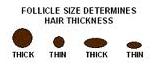
The size of your hair follicle determines the thickness.


~~~~~~~~~~

Hair Facts:
  • There's over 100,000 hair follicles on your head
  • Thick curly hair tend to be short, because sebum can't reach the length of the hair shaft causing the hair to be dry and brittle
  • Hair uses the same cells that are responsible for bone growth
  • There's a muscle fiber connected to the sebaceous gland that controls goosebumps and your hair standing up on end.
  • An unbalanced diet can cause brittle and dry hair
  • Hair gets it shine from sebum the scalp produces
  • Made of about 10% water
  • Animal hooves, claws, and feathers are made of the same thing as your hair - keratin
  • Sebaceous glands are found everywhere except on the soles of your feet and the palms of your hands
~~~~~~~~~~

If growth and retention are important to you when it comes to hair you should keep all of this in mind. Once your hair is damaged (sun, heat, chemical, etc) it can't be undone. To correct badly damaged hair your only option is to cut it. You can temporarily repair hair with smoothers, conditioners, sealants, silicones, etc, but they're not permanent solutions. Making sure you care for your hair properly can help prevent unwanted chops.


All Rights Reserved
If you copy this picture please link back to this site and give me credit ^_^" Thanks!

(Above) Blue: Cut mark   Red: conditioners
1. A healthy hair can experience slight damage from normal wear of a day. Chlorine, dyes, heated tools, winter hats, brushing, and hair accessories can all wear on your hair over time. The key is protecting your hair and being aware of its state. If you keep up with necessary trims there will be minimal hair removed.

2. After a while your hair can become frayed, experience heat damage, or break off from over processing. You may notice uneven pieces of hair, fly aways, or split ends. This is when you want to start taking action before it spreads. Unattended split ends can travel up the length of the hair causing more damage. These splits get caught on each other, and this causes tangles which can cause further damage.

3. Conditioners, silicones, and oil treatments, for example, can help temporarily seal split hairs, but it's not permanent. After washing those seals are removed and need replaced. This is why conditioning is important. Once the cuticle of your hair is damaged it can't repair itself. It's up to you to maintain and protect the hair.

4. If your hair is continually neglected, or trims aren't being done as necessary you may end up having to cut more than anticipated in order to correct the damage.

5. You can see the difference between trims. If you address it early you'll retain more length than if you put it off. Hair grows at about 1/4 inch a month so in order to retain some length you don't want to cut more than that. Example: Roughly 1.5 inches can be grown in about 6 months time. If you trim more than that it's like knocking your hair length back 6 months. So your hair may healthier if it was damaged, but you won't see the growth. That's why it's important to stay on top of it!


How often do you trim your hair? What do you do to make sure your hair is healthy?

Follow me on Twitter @MzDezy or like my Facebook Fan Page and let me know!!

Saturday, October 15, 2011

Styling Tool Quickie: Perm Rods

I prefer perm rods over rollers when it comes to curling my hair, especially over night. Hard plastic rollers hurt to sleep in, or they'll have you sleeping in impossible positions to get a half nights rest. Sponge rollers tend to dry my hair out, because they're made out of sponges and draw out moisture. So perm rods are my preferred go to styling tool for curls.

I use mid-sized (pink) and large (purple) perm rods


There are many types of perm rods, different colors, sizes, and styles. I bought mine at Sally's Beauty Supply, but they're available at most hair stores. The perm rods came in, I believe, packs of 10 for about $3. Depending on the size you can create tight curls, waves, loose curls, and they can be used on most hair lengths.


Visit H E R E!! for more detailed info!


Uses for Perm Rods (besides perms):
  • Sets- style as if doing a roller set, sub rollers for perm rods. Great for transitioning hair and TWA!
  • Sets- style as if doing a spiral set. Great for curling locs, braids, two strands, etc
  • Restyle a protective style such as mini twists

After styling my hair with perm rods I cover them with a satin bonnet to protect them while sleeping. The longer you keep the perm rods in the tighter the curls will be. If you leave them in for a short amount of time you'll have more of a wave, then a curl. You can sit under a hair drier to speed up the process if desired.

Have you used perm rods for styles other than perms? Share!

Visit H E R E!! to see results of a style I did with perm rods ^_~"

Monday, October 3, 2011

Protective Style: Senegalese Twists

When I was going through my transition phase I tried to keep my hair braided, or in some type of protective style. My plan was to wear styles like this until my hair was to a length I could work with. Wearing protective styles also help lower the anxiety I was having over transitioning. At the beginning it was extremely hard for me to do my hair since it had two completely different textures. Your hair is prone to breakage during transitioning. The part of your hair where the relaxed meets the chemical free is the weakest. You have to take great care in protecting this area specifically.

Senegalese twists are so beautiful; I love them! Just as their name suggests, they originate in Senegal, Africa. There are a few different variations that I've seen. I had mine hot water curled after they were finished.


I kept these in for a good 6 months at least. You're still able to wash, condition, and style your hair with the twists in. Whenever I felt my scalp needed cleaned I washed the twists. I just concentrating on my scalp with the shampoo to make sure it was cleaned. The remainder of the twists I gently rubbed with shampoo, and made sure to rinse very well. Even though your hair is covered in this style you still need to make sure to keep your hair moisturized. A good leave in conditioner is very important. If your scalp gets dry, or itchy just massage oil such as tea tree into your scalp. Since there are so many twists I wasn't able to put my hair under a satin bonnet at night. Instead I'd pull the twists back in a loose pony tail then tie a satin scarf around my head.


More Style Ideas:
  • Pull the twists back into a low sitting bun; add a flower or hair piece for decoration
  • Use bobby pins to make a swooping bang and add a colorful headband
  • Wear a colorful scarf as a headband
  • Make one big French braid out of the twists

Once I removed the Senegalese twists I made sure to deep condition my hair and to use a protein pack. After your hair has been in a style like this you'll notice "a lot" of hair coming out with the twists. You shouldn't be alarmed though. Your head sheds hundreds of hairs a day. Do the math, if your hairs been in twists/braids for a month--that's at least 3000 hairs. If you've been washing and conditioning properly you shouldn't have anything to worry about.

~~~~~~~~~~~~~~~~~~~~~~~~~~~~~~

Pros:
  • It's a protective style that's low maintenance
  • Not limited to just one style
  • Helps ease the stress during transitioning
  • Easy styling in the mornings
  • Less manipulation on hair
  • Don't have to worry about frizz, humidity, rain

Cons:
  • Takes at least 6 hours to get done (depending on size) and just as long to remove (recruit a friend to help)
  • Can be pricey depending on where you go (may have to pay for service and packs of hair)
~~~~~~~~~~~~~~~~~~~~~~~~~~~~~~


Scrappy and I!!!


Over all I liked this style, and in general I love it. Would I get it again-- I'd have to be ready for it; psych myself up. The only turn off for me is the time it takes to get them in and out. This is the sole reason I refuse to do mini twists on my own hair. Even if I watch movies as I do it I'm just not motivated. I honestly don't want to sit for 6 hours while someone else does it let alone me doing them!

I'd recommend Senegalese twists, or any similar protective style to anyone who's teetering on going chemical free. Like I said before, styles like these really made a difference for me. There were plenty of days I was ready to give up and grab that box of relaxer, and be done. I actually gave in twice before sticking to my decision. If I got Senegalese twists done again, I'd probably get them a bigger size than in the pictures.


Tuesday, September 27, 2011

Quickie: Stuffed Twisted Updo

I saw this style while surfing YouTube videos last week and decided to try it. The channel I saw the video on was PrettyDimples. You can find a link to her channel under my "Links" tab up top!!


I've been celebrating my birthday, my friend's birthday, and other Virgo's birthdays ALL month! I wanted to do something different with my hair for the last party we would be having. This style was simple enough to do, and didn't require me buying anything for it.


What I Used:
  • Rat-tail comb
  • Hair clips
  • 1 pack of braiding hair
  • Eco Styler Argon Oil Gel (find out more about it H E R E !! )
  • Bobby pins
  • Lighter


I started by washing my hair, adding leave-in conditioner, then blow drying it. A small section on braiding hair was folded in half, and then the fold was heated with the lighter, molded with my fingers to make a point, and then lined up with the beginning of the parted twist. Each twist has a piece of braid hair that I used to stuff the twist. After forming the twist as far as possible incorporating your own hair, keep twisting tightly to make the braid hair roll. You'll start to get the crazy twisted coils. Keep twisting til you're at the end of the braid hair, then secure with a bobby pin.

The finish results were my variation on the how-to video. I prefer bigger twists to smaller ones. Making big twists limited how much hair was left over to twist into the spirals pinned on the side. If you used smaller twists then the spiral section, in the end, will be fuller. Over all I'm happy with this style. I've gotten SO many compliments on it from friends, co workers and even strangers.


The entire style took me about 45 minutes total to do. I always multitask when it comes to doing my hair, so it usually takes me longer than if I just focused on it. The twisted updo is one I'd suggest for someone who's transitioning, wants a protective style, or just something different.

It's day 4 with this style and it's still holding strong. At night I use a satin hair scarf to protect the edges of my hair, and then cover the remaining hair with a satin hair bonnet. I also sleep on a satin pillow case-- if you don't own one, get one!! It'll be one of your hairs best friends  ^_^"

Friday, September 16, 2011

Quickie: Protective Style

Protective styles in the form of extensions were something I loved while my hair was transitioning. It took some of the anxiety I was having off of my shoulders. A simple but cute age appropriate style was OK in my book.


Simple corn rows

It took the stylist about 30 minutes to complete this style for me. With the ends down they reached just below my shoulders.


To switch up this style here are some ideas:

  • Twisted the hanging hair into a bun that was off centered at the nape of my neck
  • Add a hair flower just above my ear
  • Braid the hanging hair into one big braid
  • Make a pony tail that hangs over your shoulder

You can dress this hair style up by:

  • Adding chunk earrings with the hair pulled back
  • Add a big hair accessory, such as a flower
  • Make a pony tail using a decorative scarf
  • Form a head band out of a decorative scarf

To extend the life of this style:
  • At night put hair in loose pony tail, then cover with a satin bonnet or scarf
  • Washing your hair is still possible, just massage shampoo in between the braids, then air dry
  • If your scalp gets dry or itchy massage oil on it before bed
  • Sleep on a satin pillow case if there's no bonnet or scarf available

This protective style could've lasted a good month or more if I wanted it to. I'm particular when it comes to braids in my hair. These were removed after too much fuzzy hair was showing in the braids from me washing, and from normal wear.

To remove I cut a good majority of the hanging hair off. This made it easier for me to undo the braids. If you do this make sure not to go too high, so you don't chop off your own hair!! Afterwards be sure to deep condition your hair before styling again.

It's My (BC) Anniversary!!

I am coming up on the anniversary of my BIG CHOP (BC)!!! Deciding to go chemical free wasn't a hard decision for me. Up until I started college I actually didn't relax my hair. What pushed me into doing it was I honestly had no idea how to do my hair. Sounds bad right??

Well, back home I was able to go to a salon once a week to have someone else manage my huge head of hair. Being 100 plus miles away I was lost and confused. After relaxing it I STILL had to learn how to do my hair. Relaxing my hair wasn't the simple fix I thought it would be. The "I need my hair relaxed" phase lasted about a year or so before I was sick of it. To me, there was more maintenance, upkeep, and rules (no chlorine, avoid the rain, dance too hard and your curls will disappear, etc) that needed to be followed.

There were two attempts at transitioning my relaxed hair back into my natural state. They both failed! Failed either because it hurt SOOOOO bad to comb my hair that I couldn't take it and was near tears, or because my hair was breaking off badly. Both of these reasons caused me to go to town on my hair with scissors and a relaxer kit! The end results were super cute, but that's not the point. As you've probably heard before, the third try was the charm for me   ^_^"  What actually made a difference my third time around was I had a close friend who did a BC, and had met other people who already had natural hair. They helped me learn some things along with a hair dresser I started going to.


Strike 2: relaxed and cut my hair

Strike 1: layered and relaxed my hair


~~~~~~~~~~~~~~~~~~~~~~~~~~~~~~


Research was a big help in me transitioning. I did an online search for salons in the city that had stylists who specialized in natural and/or textured hair, then went from there. It was important to me that I had a full in person conversation with the person that I would be trusting to do my hair. There have been plenty of times I've went to salons and the stylists are confused, don't know where to begin, call others over to see, tell me it's going to cost more, ask me how I do my hair, so they can do it.....there is no way I'm sitting in your chair and letting you do anything if your initial reaction to my hair is even remotely similar to these!!!!

Luckily I did find a salon, and they offered a free consultation with the stylist. Some of the things I felt helpful that he asked, suggested, mentioned were:

  • What was my over all goal with my hair. (Health, length, etc.)
  • What products was I currently using? (Shampoo, oil sheen, hair spray, etc.)
  • Mentioned the good/bad of specific products I named that I used. (Pantene for Natural, oil sheen, etc.)
  • Suggested quality products I could find at stores myself. (Ex. Mizani)
  • Asked about my typical hair routine. (How often I wash, what tools do I use, etc.)
  • Explained why I had the issues I currently did (Breakage, etc.)
  • Explained how different hair textures had different needs (Less oil, more moisture, etc.)

In my opinion this consultation was one of the best things I could've done. We ended our consultation with him giving me a haircut. Since I was terrified of cutting off ALL of my hair at once, he suggested that I get a shorter style and start there. Cutting my hair a few inches at a time helped keep the ends healthy, let me retain a comfy length, and slowly remove the relaxed hair. I'd get about 2 inches cut once a month. When I was finally left with a few inches of relaxed hair and the rest was a comfortable length for me I was ready. My hair was still short, but it wasn't too short that I didn't feel good about it. If you're in doubt or self conscious it'll show no matter how sweet your haircut is.


Courtesy of Mr. "Don't Use My Gov't Name" aka UIPHOTOS ^_^
Check him AND more of me out   H E R E !!

~~~~~~~~~~~~~~~~~~~~~~~~~~~~~~


It took about 6 months for me to finally say, "DO IT!" The picture above is what was left when every single chemically relaxed strand of hair was gone from my head and I loved it!! It's been a rap ever since and I haven't turned back.

The journey definitely wasn't always easy, and I honestly have had my fair share of discouraging time, but as you can see I'm still going strong! Some things I did to keep my head up before and after my BC was:

  • Talk to friends and strangers who were chemical free to find out tips, get help, etc.
  • Find blogs online for how-to's, product suggestions
  • Splurge on products in clearance bins to try for cheap
  • Join "Meet Up" groups that are geared towards natural hair, or just the interest
  • Keep in touch with your stylist for pointers
  • Find local support groups/events
  • Watch YouTube vlogs (keywords: natural hair, big chop, encouragement, natural hair styles, etc.)
  • Be open to trying new styles, or accessories you wouldn't have before
  • Remember that opinions are just that..opinions, and everyone has one (family and close friends included)
  • Search for books at your local library

~~~~~~~~~~~~~~~~~~~~~~~~~~~~~~


The last time I had a relaxer put in my hair (take #3) was fall of 2007. I transitioned from there to my BC in 2008! So for about 4 years I've been relaxer free. Occasionally I would get my hair cut into different styles, and of course keep up with trims as needed. My hair grows fast, but maintaining HEALTHY hair is my biggest goal so losing a couple of inches to make sure it's at its best doesn't worry me. I'm having fun trying new styles, meeting people (chemical free or not), and learning new things about hair in general. It's definitely been a journey with some bumps, but I'm in it for the long haul!